
1 March / 22 March 2024
Author Portraits
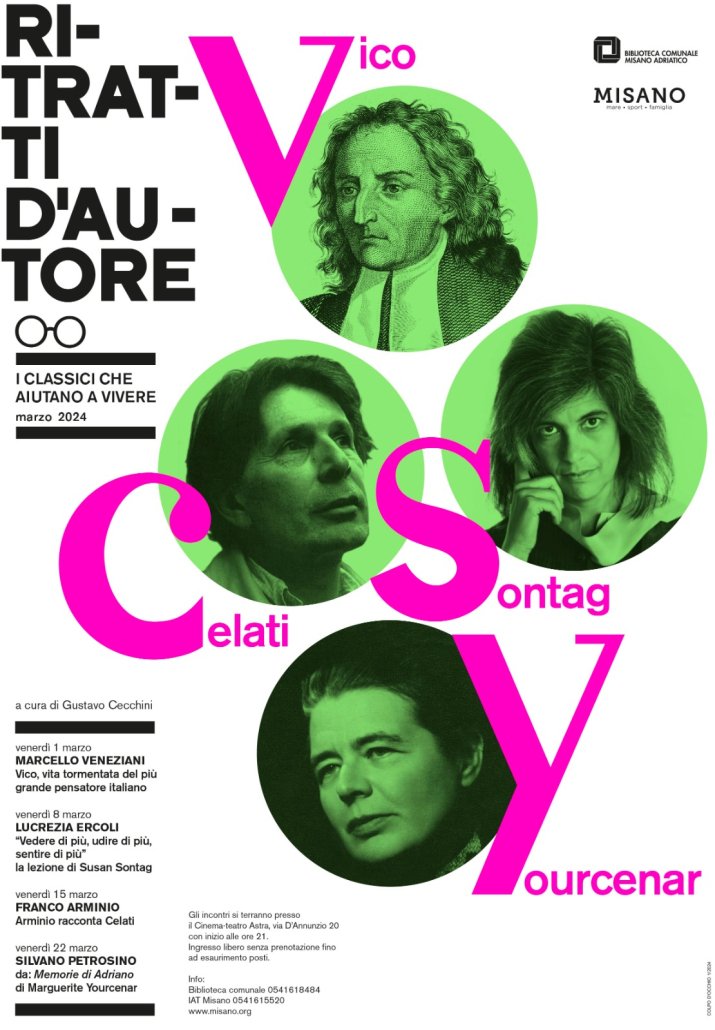
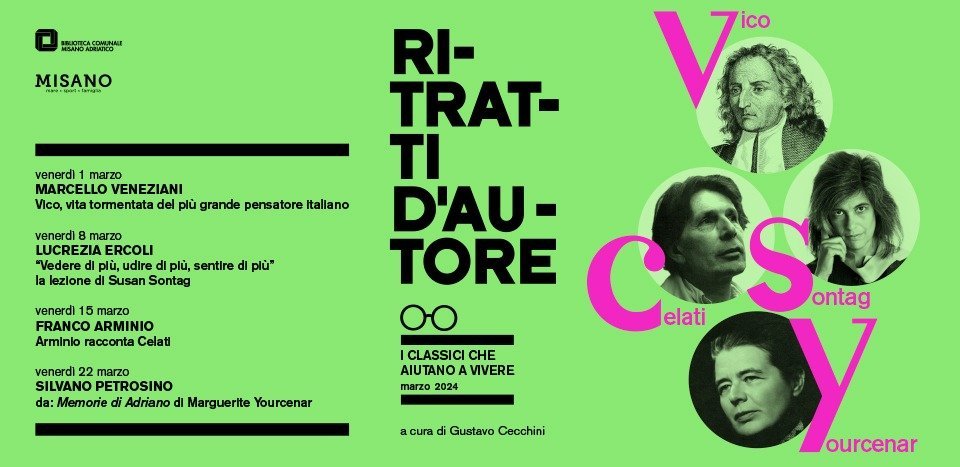
How can we look at the world that passes before us today without knowing what we've left behind?, Friday 1 March, the new edition of Portraits by experts – the classics that help you live. There are four appointments, under the direction of Gustavo Cecchini, where the protagonists are the classics of thought, those texts that demonstrate incredible vitality, from which we should take example for all forms of resistance, civil, cultural, human, to which we are called every day. The question then is not whether the classics are still relevant, the question is whether we are relevant with respect to the classics, because most likely we are not. The classics remain and each time they tell us something new. Rereading a classic, then, means becoming aware of the reasons for this present and having the tools to understand it better and change it when needed. It is the path that reveals the challenge that the seekers of yesterday's thought throw to today's sedentary travellers.
To open the review Friday 1 March is Marcello Veneziani with a lecture entitled: Vico, the tormented life of the greatest Italian thinker. «But who is that thin, shortish Christian with the pointed stick who crosses Spaccanapoli every morning? He always goes alone, walks slowly, seems a bit hunched, as they say here… The man of modest bearing and unassuming appearance who in 1730 – at the age of sixty-two – walks the streets of Naples is in reality one of the most brilliant and influential thinkers of his time, perhaps the most important of all: Giambattista Vico. He has just published the second edition, revised and expanded, of his masterpiece: The New Science. That year and that work will consecrate him »to posterity and notoriety, marking the beginning of his golden age«. A period, however, far too brief, because his fundamental contribution has often been misunderstood or belittled, both by his contemporaries and by posterity. Yet, from the Middle Ages to the twentieth century, Vico »excels, anticipates times and thoughts, leaves footprints destined to bear fruit and sows insights that will nourish the thoughts and thinkers of the future«. As Marcello Veneziani will remind us, Vico stands at the crossroads of Mediterranean culture; »he founds the thought of history, nourishes philosophy with philology, intuits the fabulous and poetic origins of humanity, interweaves reason and imagination, tradition and modernity, a Christian vision and a classical vision of history, designs a civil theology, traces back to the sources of religion and finally finds in human, historical and worldly events the trace of God and Providence«. With the flair of a storyteller and the precision of a historian, Veneziani will tell us the troubled life of one of the great philosophers of our tradition.
“See More, Hear More, Feel More” Susan Sontag's Lesson It is the theme of the second appointment, on Friday 8th March, with philosopher Lucrezia Ercoli. What is important today is to reawaken our senses. ”We must learn to see more, to hear more, to feel more“, writes Susan Sontag, one of the most influential intellectuals of the late twentieth century. Her work as a writer, essayist, and journalist, exactly twenty years after her death in 2004, helps us to ”see more and feel more“, to understand the complexity of contemporary culture where high and low mix and blur. Her incisive essays on cinema, photography, theatre, homosexual culture, the female condition, and illness remain incredibly relevant. And in the terrible times we are living through – when war has returned to knock on the doors of the West – her reflections on the spectacle of evil, which we experience daily through the mass media and social networks, are precious. How should we react, she asks us in her last book written before she died, when we are "faced with the pain of others"?
The guest of Friday 15 March He is the poet Franco Arminio what will it tell Gianni Celati. Arminio says: Gianni Celati was my teacher, the teacher of many.
I will tell of his way of looking at the world, his sympathy for the perceptive, his distance from abstractions, from conformism.
Celati looked out, he was attentive to the colours of things, to the taste of the air and to everything that revolved around them.
He knew that life is about existing in changing space, through passing time. I will speak in particular about "Verso la foce" (Towards the Estuary), his journey through the Emilian plains. Today, an awareness of places is more important than ever; it is the first form of respect.
Special closing, Friday 22nd March in the company of the philosopher Silvano Petrosino which will be measured with Memoirs of Hadrian of Marguerite Yourcenar. The writer does not intend to write an essay on Hadrian's life, nor a biography, but a text capable of gathering and giving voice to his memories. Yet, what is more secret, more unattainable, more unimaginable, and consequently impossible to narrate, than the memories of another? Is not memory what is most intimate, most personal, the very hallmark of a subject's uniqueness? Could one therefore conclude that in truth these memories of Hadrian are nothing more than Yourcenar's own? In a sense, certainly yes, even though one cannot hide that it is precisely from such a conclusion, so obvious as to border on the banal, that the great French writer sternly distances herself: “How coarse are those who say: ‘Hadrian, you are you'.” But then, whose memories are these?
The meetings will be held at the Astra Cinema-Theatre, via D’Annunzio 20, with Start all 9:00 PM.
Free entry without booking until all places are filled.
More information:
Public library 0541 618484
IAT Misano: 0541 615520
www.misano.org